
ব্লগ বিস্তারিত
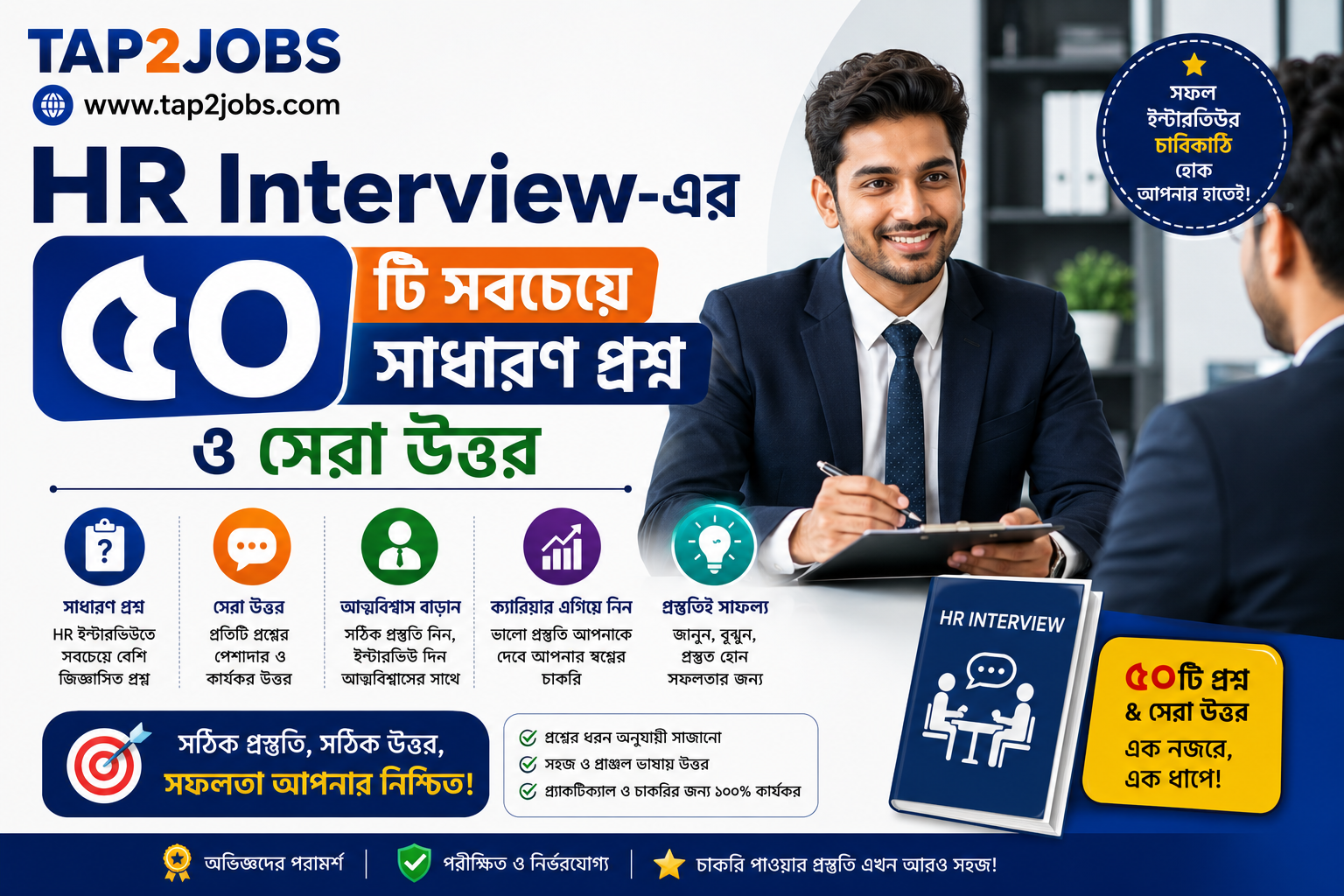
50 Most Common HR Interview Questions and Best Answers

Super Admin
|আগ 1 2026
|0 মন্তব্য
Visit: www.tap2jobs.com
50 Most Common HR Interview Questions and Best Answers
Job interviews can be challenging, especially when you are unsure about what an HR interviewer may ask. HR professionals commonly ask specific questions to understand a candidate's personality, skills, communication ability, problem-solving approach, work experience, and ability to adapt to the organization.
In this complete guide, we cover 50 of the most common HR interview questions and effective sample answers to help job seekers prepare for their next interview.
Important: Do not memorize these answers word-for-word. Customize each answer based on your own experience, skills, education, and career goals.
1. Tell Me About Yourself
Why Does HR Ask This Question?
This question helps the interviewer understand your background, communication skills, confidence, and ability to summarize your professional experience.
Sample Answer
“My name is Rahim Hasan. I completed my BBA from the University of Dhaka. I am currently working as an Accounts Executive, where I have gained experience in financial reporting, VAT, tax, and ERP software. I am interested in learning new skills and taking on greater responsibilities while contributing to the growth of the organization.”
2. Why Do You Want to Work for Our Company?
Sample Answer
“I am attracted to your organization because of its reputation, professional work environment, and opportunities for employee development. I believe my skills and experience can contribute to achieving the company's goals.”
3. Why Are You Suitable for This Job?
Sample Answer
You can highlight:
- Relevant skills
- Practical experience
- Ability to learn quickly
- Teamwork skills
- Knowledge related to the position
Focus on the qualifications that directly match the job description.
4. What Is Your Greatest Strength?
Examples
Depending on the position, you can mention strengths such as:
- Problem Solving
- Leadership
- Communication
- Time Management
- Quick Learning
- Teamwork
- Adaptability
Choose strengths that you can support with real examples.
5. What Is Your Weakness?
Sample Answer
“I used to feel somewhat uncomfortable with public speaking. However, I am improving this area through regular presentations and practice.”
When discussing a weakness, mention what you are doing to improve it.
6. What Is Your Greatest Achievement?
Sample Answer
“In my previous organization, I helped automate a reporting process, which reduced the time required to prepare monthly reports by approximately 30%.”
Whenever possible, describe your achievement using measurable results.
7. Where Do You See Yourself in Five Years?
Sample Answer
“I see myself as a skilled professional who is taking on greater responsibilities and contributing as a valuable team member or team leader.”
Your answer should demonstrate realistic career development and a willingness to grow with the organization.
8. Why Are You Leaving Your Previous Job?
Important Tip
Avoid criticizing your previous company, manager, or colleagues.
Sample Answer
“I am looking for new challenges, learning opportunities, and career growth, which is why I am interested in exploring a new opportunity.”
Keep your answer professional and focused on your future career goals.
9. Can You Work Under Pressure?
Sample Answer
“Yes. I prioritize my tasks, plan my work carefully, and focus on completing responsibilities within the required deadlines even during busy periods.”
10. What Is Your Understanding of Teamwork?
Sample Answer
“I believe a successful team depends on mutual cooperation, effective communication, accountability, and a willingness to support one another.”
11. Can You Take Leadership?
If You Have Experience
Give a specific example of a situation where you led a team, project, or task.
If You Are a Fresher
“I am willing to take responsibility when needed and have a strong willingness to learn and develop my leadership skills.”
12. What Are Your Salary Expectations?
Sample Answer
“Based on my skills, experience, and the responsibilities of the position, I am looking for a competitive salary in line with the organization's compensation policy.”
Avoid giving an unrealistic salary expectation without considering the role, market conditions, and your qualifications.
13. How Do You Resolve Conflicts?
Sample Answer
“I first listen to both sides, try to understand the root cause of the problem, and then work toward a reasonable solution that addresses the issue professionally.”
14. What Was Your Biggest Failure?
Sample Answer
“Earlier in my career, I faced some challenges with time management. I improved the situation by planning my work more carefully and prioritizing important tasks.”
Focus on what you learned and how you improved rather than simply describing the failure.
15. What Do You Do When You Make a Mistake?
Sample Answer
“I acknowledge the mistake, correct it as quickly as possible, and learn from the experience so I can avoid making the same mistake in the future.”
16. Why Should We Hire You?
Sample Answer
“My relevant skills, willingness to learn, and responsible attitude make me a suitable candidate for this position. I am committed to learning quickly and contributing to the organization's goals.”
Support your answer with skills and examples relevant to the specific job.
17. What Motivates You?
Examples
You can mention:
- Learning new things
- Solving problems
- Contributing to organizational success
- Developing your skills
- Achieving meaningful goals
Choose motivations that genuinely apply to you.
18. How Do You Manage Your Time?
Sample Answer
“I prioritize tasks based on their importance and deadlines, then create a plan to complete each responsibility within the required timeframe.”
19. How Would Your Colleagues Describe You?
Sample Answer
“They would probably describe me as responsible, cooperative, supportive, and positive.”
Choose qualities that your colleagues can realistically confirm.
20. How Do You Learn New Things?
Sample Answer
“I learn new skills through online courses, practical work, guidance from experienced colleagues, and regular practice.”
21. Are You Willing to Work Overtime?
Sample Answer
“Yes. When necessary and when required by the organization's workload, I am prepared to work additional hours to complete important responsibilities.”
22. How Do You Handle Stress?
Sample Answer
“I break larger tasks into smaller steps, prioritize my responsibilities, and work calmly toward practical solutions.”
23. What Is Your Biggest Professional Achievement?
Sample Answer
Give a specific example from your career.
Possible examples include:
- Achieving a sales target
- Reducing costs
- Improving a business process
- Increasing customer satisfaction
- Improving productivity
- Completing an important project
Use the STAR Method when explaining a significant achievement.
24. What Is Your Career Goal?
Sample Answer
“My long-term goal is to continuously improve my skills, create value for the organization, and gradually take on greater responsibilities.”
25. Do You Have Any Questions for Us?
Always Ask Relevant Questions
Examples include:
- What are the main responsibilities of this position?
- How will success be measured during the first six months?
- Are there training and professional development opportunities?
- What is the team structure?
- What are the main priorities for this role?
Asking thoughtful questions can help you better understand the position and organization.
26. What Is Your Biggest Responsibility in Your Current Job?
Sample Answer
“I am currently responsible for planning daily tasks, preparing reports, coordinating with team members, and ensuring that assigned work is completed within the required timeframe.”
27. What Would You Do If Your Manager Made a Mistake?
Sample Answer
“First, I would try to understand the situation respectfully. If necessary, I would share my concerns politely at an appropriate time and support my point with relevant facts or information.”
28. What Would You Do If a Team Member Was Not Performing Their Work?
Sample Answer
“First, I would try to understand the reason for the problem. If appropriate, I would offer support and discuss the situation with the team leader or manager if further assistance was required.”
29. How Do You Meet Tight Deadlines?
Sample Answer
“I divide the work into smaller tasks, prioritize the most important responsibilities, and regularly monitor my progress to ensure that everything is completed on time.”
30. How Do You Handle Multiple Tasks at the Same Time?
Sample Answer
“I prioritize tasks according to their urgency and importance, use a to-do list, and organize my schedule so that each responsibility is completed within the required timeframe.”
31. What Was Your Biggest Professional Challenge?
Sample Answer
“I once had to complete an important project within a very limited timeframe. Through careful planning and teamwork, I was able to complete the project successfully within the deadline.”
32. Are You Willing to Learn New Technologies?
Sample Answer
“Absolutely. I believe continuously learning new technologies and keeping my skills updated is important in today's job market.”
33. What Will You Do If You Do Not Get This Job?
Sample Answer
“I will continue improving my skills, learn from the experience, identify areas where I can improve, and prepare myself for future opportunities.”
34. How Do You Handle Customer Complaints?
Sample Answer
“I first listen carefully to understand the customer's concern, respond with empathy, and try to find a quick and appropriate solution according to the company's policies.”
35. Can You Work Remotely?
Sample Answer
“Yes. I can work effectively in a remote environment by using online meeting platforms, project management tools, and regular communication with team members.”
36. What Would You Do If You Disagreed With a Colleague?
Sample Answer
“I would try to discuss the issue with the colleague professionally and find a mutually acceptable solution. If necessary, I would seek guidance from a manager.”
37. How Do You Receive Feedback?
Sample Answer
“I consider feedback an opportunity to learn and improve. I listen carefully to constructive feedback and use it to improve my performance.”
38. How Do You Stay Motivated?
Sample Answer
“Learning new things, setting clear goals, and seeing positive results from my work help keep me motivated.”
39. What Does Success Mean to You?
Sample Answer
“For me, success means achieving my goals while maintaining honesty, responsibility, continuous improvement, and a positive professional attitude.”
40. How Do You Handle Failure?
Sample Answer
“I analyze the reasons behind the failure, learn from the experience, and use those lessons to perform better the next time.”
41. Are You Willing to Travel for Work?
Sample Answer
“If travel is required as part of the job responsibilities, I am willing to travel as needed.”
42. Are You Willing to Work in Another City?
Sample Answer
“Depending on the organization's requirements and the opportunity, I am open to working in another city.”
43. Are You Willing to Work in Shifts?
Sample Answer
“If shift work is required for the position, I am prepared to work according to the organization's schedule.”
44. Give an Example of Your Leadership Skills
Sample Answer
“During a university project, I worked as the team leader. I assigned tasks, monitored progress, coordinated with team members, and helped solve problems so that we could successfully complete the project.”
Whenever possible, use a real example from your academic or professional experience.
45. How Do You Make Decisions?
Sample Answer
“I analyze the available information, consider potential risks and outcomes, and try to make decisions that align with the organization's goals.”
46. Can You Make Quick Decisions Under Pressure?
Sample Answer
“Yes. However, before making a quick decision, I try to gather the necessary information and consider the available options so that I can make a practical and reasonable decision.”
47. What Has Been Your Biggest Learning Experience?
Sample Answer
“I have learned that proper planning, effective communication, and teamwork can make a significant difference when completing challenging tasks successfully.”
48. How Do You Improve Your Skills?
Sample Answer
“I regularly take online courses, read books and industry resources, attend webinars, and develop new skills through practical work and continuous practice.”
49. Why Should We Choose You Over Other Candidates?
Sample Answer
“My relevant skills, willingness to learn, sense of responsibility, and positive attitude make me a suitable candidate for this position. I can adapt to a new environment quickly and focus on delivering meaningful results.”
Avoid criticizing other candidates. Focus on your own qualifications and what you can contribute.
50. Do You Have Any Final Message for Us?
Sample Answer
“Thank you for considering my application. If given the opportunity, I would like to contribute to the organization's goals through dedication, honesty, and my best efforts while continuing to learn and grow professionally.”
What Should You Do on Interview Day?
Follow these practical interview tips:
✅ Arrive 15–20 minutes early.
✅ Keep your mobile phone on silent.
✅ Greet the interviewer confidently and politely.
✅ Listen carefully to every question.
✅ Give concise answers supported by real examples.
✅ Maintain professional body language.
✅ Thank the interviewer before leaving.
What Should You Avoid on Interview Day?
❌ Do not make negative comments about your previous company or manager.
❌ Avoid sharing unnecessary personal information.
❌ Do not make exaggerated or false claims.
❌ Do not interrupt the interviewer before the question is finished.
❌ Avoid overly informal behavior.
❌ Do not make salary the entire focus of the interview.
Final Interview Preparation Tips
A successful interview is not only about giving the “right” answers. It is also about demonstrating confidence, honesty, communication skills, professionalism, and a willingness to learn.
The purpose of HR interview questions is generally to understand your experience, problem-solving ability, communication style, work approach, and ability to adapt to the organization's working environment.
Therefore, do not memorize sample answers word-for-word. Instead, customize them according to your own experience and use real examples whenever possible.
For behavioral questions, you can use the STAR Method — Situation, Task, Action, Result — to structure your answers clearly and effectively.
Frequently Asked Questions (FAQ)
What are the most common HR interview questions?
Common HR interview questions include “Tell me about yourself,” “Why should we hire you?”, “What are your strengths and weaknesses?”, “Why do you want to work for our company?”, and “Where do you see yourself in five years?”
How should I answer HR interview questions?
Answer clearly, honestly, and confidently. Use real examples from your professional, academic, internship, or volunteer experience whenever relevant.
What should a fresher say when asked about experience?
Freshers can discuss academic projects, internships, training, volunteer activities, teamwork, technical skills, and their ability to learn quickly.
How should I answer “Why should we hire you?”
Focus on your relevant skills, qualifications, experience, achievements, and willingness to contribute to the organization. Connect your strengths directly to the requirements of the position.
What should I say about my weakness in an interview?
Choose a genuine but manageable weakness and explain the steps you are taking to improve it. Avoid presenting a weakness that directly prevents you from performing the essential duties of the job.
Should I ask questions at the end of an HR interview?
Yes. Asking relevant questions about the role, team, expectations, training, and career development can help you understand the opportunity better.
Visit: www.tap2jobs.com
বিভাগ :
সম্পর্কিত ক্যারিয়ার নিবন্ধ
সব নিবন্ধ দেখুন











মন্তব্য (0)