
ব্লগ বিস্তারিত
Job Interview Preparation: Complete Guide to Interview Success

Super Admin
|আগ 1 2026
|0 মন্তব্য
Visit: www.tap2jobs.com
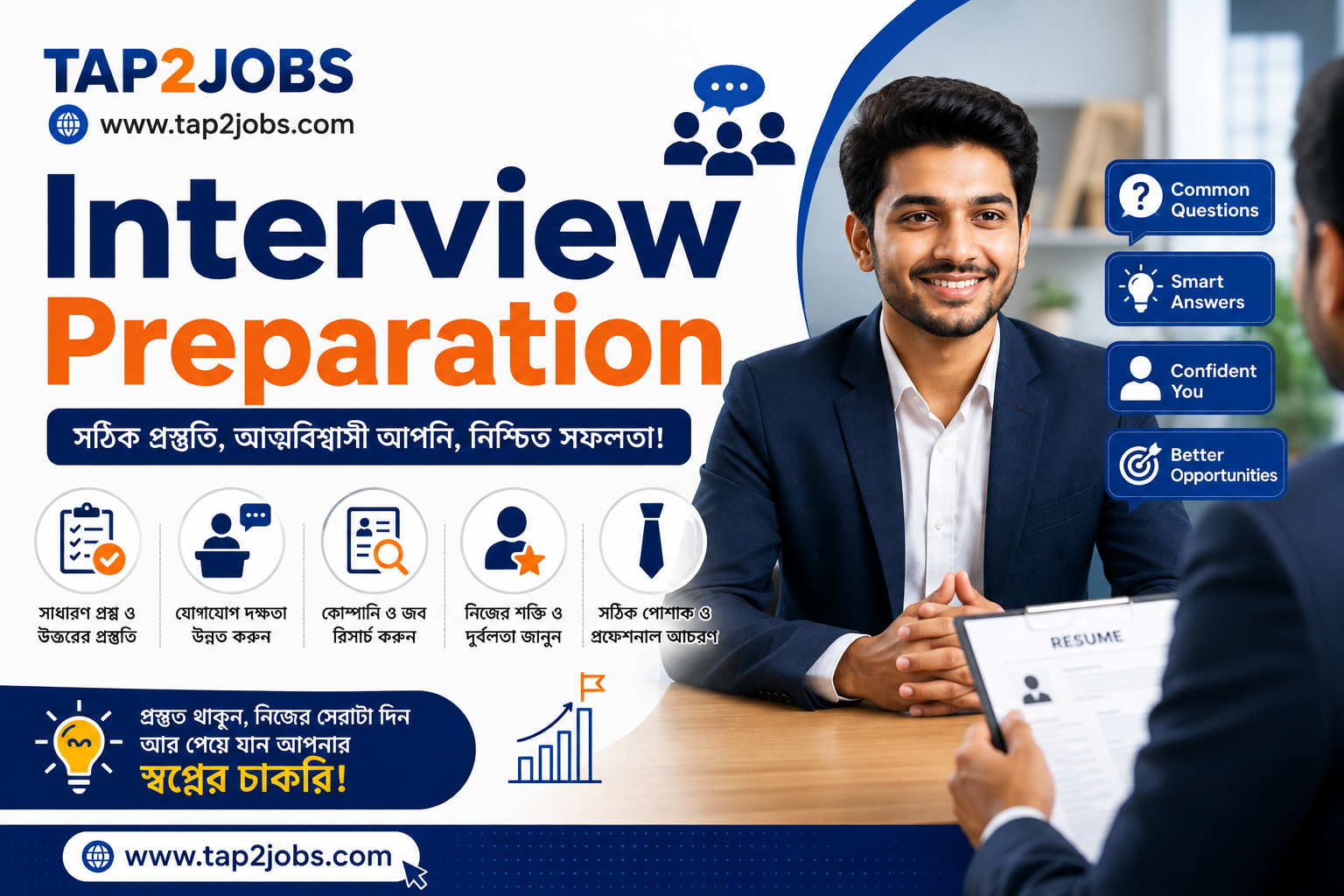
Interview Preparation: Complete Guide to Succeeding in a Job Interview
After submitting a job application, the job interview is one of the most important stages of the hiring process. A good CV can help you get an interview, but the final hiring decision often depends significantly on your interview performance.
Whether you are applying to a government organization, private company, multinational corporation, bank, NGO, IT company, or another organization in Bangladesh, proper interview preparation can help you attend the interview with greater confidence.
In this complete guide, you will learn how to prepare for a job interview, what to do before and during the interview, how to answer common questions, and how to avoid common interview mistakes.
Why Is Interview Preparation Important?
Many candidates have strong educational qualifications but fail to perform well in interviews because they are not adequately prepared.
Good interview preparation can help you:
- Build confidence
- Answer questions clearly
- Make a positive impression on the employer
- Communicate your skills and experience effectively
- Demonstrate professionalism
- Prepare for difficult questions
- Improve your chances of performing well against other candidates
What to Do Before a Job Interview
1. Research the Company
Before attending an interview, learn as much as possible about the company.
Research:
- Company history
- Products or services
- Mission
- Core values
- Recent activities
- Industry and business operations
- Office location
HR professionals often ask:
“What do you know about our company?”
A well-prepared answer shows that you are genuinely interested in the organization and the position.
2. Read the Job Description Carefully
Many candidates attend interviews without thoroughly reviewing the job description.
Pay attention to:
- Job responsibilities
- Required skills
- Experience requirements
- Software or technical knowledge
- Educational qualifications
- Job location
- Other requirements
Then compare these requirements with your own qualifications and prepare examples that demonstrate your suitability for the position.
3. Review Your CV Carefully
Anything mentioned on your CV can become an interview question.
Be prepared to discuss:
- Final-year projects
- Internship experience
- Previous jobs
- Skills
- Training
- Certifications
- Achievements
- Academic background
Never include false, misleading, or exaggerated information on your CV. Make sure you can confidently explain everything you have listed.
Most Common Job Interview Questions
1. Tell Me About Yourself
This is one of the most common interview questions.
Your answer can include:
- Your name
- Educational qualifications
- Professional experience
- Current job or activities
- Relevant skills
- Career goals
Try to keep your answer within 2–3 minutes and focus on information relevant to the position.
2. Why Do You Want to Work for Our Company?
Avoid answering simply:
“Because the salary is good.”
Instead, talk about:
- The company's reputation
- Learning opportunities
- Career growth
- Company culture
- How your skills match the position
3. What Are Your Strengths?
Examples include:
- Quick learning
- Problem-solving
- Teamwork
- Leadership
- Communication skills
- Time management
- Adaptability
Choose strengths that are relevant to the position and support them with practical examples when possible.
4. What Is Your Weakness?
Choose a genuine weakness that you are actively working to improve.
Example:
“I used to feel somewhat uncomfortable with public speaking. However, I am currently improving this skill through regular presentations and practice.”
The important part is to demonstrate self-awareness and continuous improvement.
5. Where Do You See Yourself in Five Years?
You can discuss:
- Becoming a skilled professional
- Taking on greater responsibilities
- Developing leadership skills
- Contributing to the organization
- Building a long-term career
Avoid giving an unrealistic answer. Focus on professional growth and continuous learning.
Technical Interview Preparation
If you are applying for an IT, engineering, accounting, marketing, finance, or other specialized position, prepare for technical questions related to your field.
You should:
- Review your academic subjects
- Practice solving practical problems
- Refresh relevant software skills
- Review important technical concepts
- Prepare to discuss your projects
- Understand the technical requirements of the job
For example, a software developer should review programming concepts and projects, while an accounting candidate should revise accounting principles, Excel, financial reporting, and relevant accounting software.
Interview Dress Code
Your appearance should be clean, neat, and appropriate for the organization and position.
For Men
Consider wearing:
- A clean formal shirt
- Formal trousers
- A suitable belt
- Formal shoes
- Neatly groomed hair
- Light fragrance, if desired
For Women
Suitable options may include:
- Formal Salwar Kameez
- Saree, when appropriate
- Formal shoes
- Neat and professional clothing
- Light makeup, if desired
Avoid clothing or accessories that are excessively flashy or distracting.
Arrive on Time
Try to arrive at least 15–20 minutes before your scheduled interview time.
Arriving early allows you to:
- Reduce stress
- Become familiar with the environment
- Organize your documents
- Prepare yourself mentally
- Demonstrate punctuality
Plan your route in advance, especially if the interview location is unfamiliar.
Pay Attention to Your Body Language
Positive body language can make a strong professional impression.
Remember to:
- Greet the interviewer politely with a smile
- Maintain appropriate eye contact
- Sit upright
- Avoid unnecessary hand or leg movements
- Listen carefully
- Wait until the interviewer finishes the question before answering
Your body language should appear natural and professional rather than forced.
What Should You Bring to an Interview?
Depending on the job and employer, consider bringing:
- 2–3 printed copies of your CV
- Passport-size photographs
- Academic certificates or copies
- Experience certificates
- NID copy, if required
- A pen
- A notebook
- Relevant portfolio or project documents, if applicable
Keep your documents organized in a professional folder.
What to Do During the Interview
During the interview:
- Speak politely and professionally
- Listen carefully to each question
- Make sure you understand the question before answering
- Keep your answers relevant and concise
- Give practical examples when appropriate
- Maintain positive body language
- Be honest about your skills and experience
If you do not know the answer to a question, you can politely say:
“I do not currently have a complete understanding of this topic, but I am interested in learning more about it.”
Being honest is better than providing incorrect information.
Common Interview Mistakes to Avoid
❌ Arriving late
❌ Forgetting to put your phone on silent
❌ Criticizing a previous employer or manager
❌ Showing excessive overconfidence
❌ Providing false information
❌ Avoiding eye contact completely
❌ Wearing unprofessional or untidy clothing
❌ Giving unnecessarily long answers
❌ Interrupting the interviewer
❌ Focusing too heavily on salary during the initial discussion
How to Answer Salary Expectation Questions
HR may ask:
“What are your salary expectations?”
Before answering, research the typical salary range for similar positions and consider your qualifications, experience, responsibilities, and the overall compensation package.
You can give a reasonable salary range rather than an inflexible figure.
Sample Answer
“Considering the responsibilities of the position, the overall benefits, and the organization's compensation policy, I am expecting a competitive salary that is appropriate for my skills and experience.”
Keep the discussion professional and remain open to understanding the complete compensation package.
What to Do After the Interview
After completing your interview:
- Thank the interviewer
- Leave politely
- Send a short follow-up or thank-you email when appropriate
- Be patient while waiting for the result
- Reflect on your performance
- Note areas you can improve for future interviews
Even if you are not selected, the experience can help you prepare better for your next opportunity.
Online Interview Preparation Tips
Many organizations now conduct interviews through platforms such as Zoom, Google Meet, or Microsoft Teams.
For an online interview:
- Ensure you have a stable internet connection
- Choose a quiet environment
- Test your camera
- Test your microphone
- Use a clean and professional background
- Charge your laptop or mobile device
- Close unnecessary applications and notifications
- Join the meeting a few minutes early
Conduct a test call before the interview if possible.
Interview Preparation Checklist
Before attending your interview, make sure you have:
✅ Researched the company
✅ Read the job description carefully
✅ Reviewed your CV
✅ Prepared relevant documents
✅ Selected appropriate interview attire
✅ Confirmed the interview location or online meeting link
✅ Planned your travel or internet setup
✅ Practiced common interview questions
10 Job Interview Tips for Success
- Stay confident.
- Be honest.
- Communicate clearly.
- Listen carefully to every question.
- Use real examples in your answers.
- Maintain professional body language.
- Be punctual.
- Research the company before the interview.
- Dress professionally.
- Show a willingness to learn and grow.
Conclusion
A job interview is more than just a question-and-answer session. It is an opportunity for employers to evaluate your knowledge, communication skills, professional behavior, problem-solving ability, attitude, and suitability for the role.
Proper job interview preparation, confidence, honesty, and a positive attitude can help you present yourself effectively.
Remember that every interview is also a learning opportunity. If you are not successful in one interview, do not become discouraged. Identify areas for improvement, strengthen your preparation, and continue working toward your next opportunity.
If you are looking for the latest jobs in Bangladesh, career advice, CV and cover letter tips, and more interview preparation guides, visit TAP2JOBS regularly and keep your profile updated.
Frequently Asked Questions (FAQ)
1. How many days should I prepare for a job interview?
Start preparing as early as possible. Once you receive an interview invitation, spending at least 1–2 hours each day reviewing the company, job description, CV, technical topics, and common interview questions can help you prepare effectively.
2. What should I do if I do not know the answer to an interview question?
Do not provide false information. Politely acknowledge that you do not currently know the answer and express your willingness to learn.
3. What should I wear to a job interview?
Choose clean, neat, professional, and appropriate formal clothing based on the company and position.
4. Is it mandatory to speak English in a job interview?
No. The language of the interview depends on the organization and position. However, if English communication is an important requirement of the job, prepare to answer relevant questions in English.
5. Should I follow up after a job interview?
Yes. When appropriate, sending a short and polite thank-you or follow-up email can demonstrate professionalism and continued interest in the position.
Visit: www.tap2jobs.com
বিভাগ :
সম্পর্কিত ক্যারিয়ার নিবন্ধ
সব নিবন্ধ দেখুন










মন্তব্য (0)